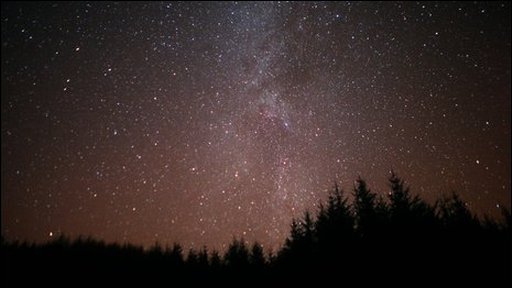
Ok so any room with no windows and the lights turned off will probably count as the darkest place in Britain. So we might need a little more definition here, the darkest place in Britain that is outdoors and you can visit to gaze at the stars is what we are really searching for here.
So where to we begin a list, a top ten count down, shimmering with excitement, or not as this is a dark list. No lets just get straight to the good stuff, the darkest place in the UK is Loch Trool in Galloway Forest Park, Scotland!
Dark skies over Galloway Forest Park - Image from Google Images
Journeying beyond the known universe could now be possible. With the revelations earlier this year that it is possible to travel faster than the speed of light, verification tests ruling out errors in messument of the Gran Sasso National Laboratory experiment allowing.
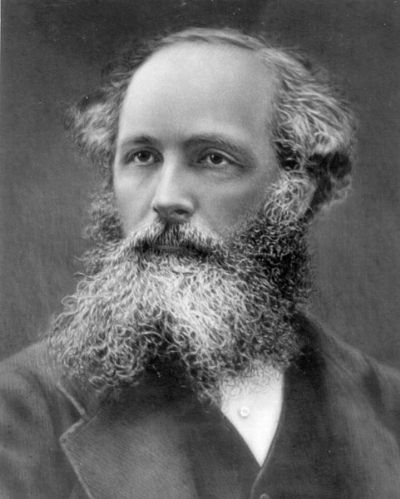
James Clerk Maxwell
For the first time in 146 years the science community could now contemplate a trip to travel beyond the universe. Its 96 years if you take Einstein as the bench mark for capping the max speed of everything in motion at the speed of light and not James Clerk Maxwell, but the latter has more magnetism! It’s a simple affare, all man need do is build a machine to accelerate past light speed, catch up with the leading edge of the ever expanding universe and wave his or her passport at what ever omnipresent inter universal boarder guard we flash past (ops, as we are moving faster than light they won’t see us, coming or going. Doppler effects of light waves withstanding).
So the plan is afoot then. Well I propose the “U prize” for the first person to do it. Notes to perspective “U prize” contestants:
1) You will need to go meny times light speed to get passed the boarder in your own lifetime. Its about 46.6 billion light years away, so you if you are now around 30 years old and want to get back to retire, say at 60 you have to travel at 578,717.313 billion Miles per second – Heres the calculation (46.billion / 186282.397) *15*365.25*24*60*60 where 186282.397 is the number of miles light travels in a vacuum per second.
2) You had better invent a new fuel source. The current sources of propulsion would require require a rocket bigger than all the stella bodies in the solar system put together to generate enough acceleration and deceleration needed for such a journey one way, let alone round trip, as there are no gravitational objects at the destination to give you any sling shot effect.
I wonder what they sell at the inevitable outside the universe gift shop?
Not all is as it appears in Scotland as objects move uphill on their own accord. In an area known as the Electric Brae, visitors have been baffled for centuries as they watch the seemingly impossible happen.
Electric Brae stone maker - google images
In what is an entirely natural phenomenon the landscape conspires to trick the eye of the bemused bystander observing movement along an apparent uphill section of road. If one places a ball on the ground and then steps away the ball will start to run uphill. In reality nothing unearthly has occurred. The ball is actually rolling downhill, all be it a very slight angle to the horizontal, and it is the viewer of this apperation that is the actual cause of this oddity of nature.
Arecales (Arecaceae aka Palmae) in an order of the flowering plants containing the Palm Tree family. There are around 2500 species of palms and many of them are some of the most important plants on the planet because of their economic value.
Coconut Palm - Picture credit The Royal Botanical Gardens Kew
Perhaps the most well known palm is the Coconut Palm, doyenne of the picture post card and guardian of many deserted sailors seeking shade, this tree is farmed world wide for its fruit the coconut. It is believed to have originated in the west Pacific, spreading by sending its fruits, coconuts, via the ocean waves. It is now ubiquitous in the tropics and glass houses of the world. Coconut Palm facts: height 30m, latin name Cocos nucifera.
The Betel Nut Palm is cultivated for tis seeds, that release a psychoactive substance when chewed. Originating from south east Asia, this palm has spread the world ,especially in sub saharan Africa because of its drug use. Betel Nut Palm facts: height 25m, latin name Areca catechu.
betel nut palm - image credit - unknown
The Desert Fan Palm’s dead foliage hanging beneath its crown provides shelter for the birds and insects in the deserts of southern California, Arizona and Nevada. Desert Fan Palm facts: height 18m, latin name Washingtonia filifera.
The Sugar Palm is one of the economic main stays of the Arecales order, cultivated in the Indian sub-continent and south east Asia. Sugar Palm facts: height 20m, latin name Arenga pinnate.
The Petticoat Palm, a native of the island of Cuba in the Caribbea,n is so called because of the skirt of dead leaves around it crown. Petticoat Palm facts: height 7m, latin name Copernicia macroglossa.
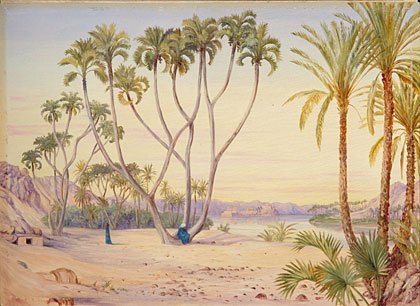
Date Palm - Picture credit Royal Botanical Gardens Kew
Feeling hungry? well the Date Palm is the tree of choice for you then. The fruits are often a staple source of complex carbs for the local community, not to mention the gift of choice to give for old age hospital dwellers. Date Palm facts height 30m, latin name Phoenix dactylifera.
Cultivated for the oils contained in its fruit, the African Oil Palm is a native of the tropical lowlands. African Oil Palm facts: height 20m, latin name Elaeis guineensis.
Perhaps more widely known for its ornamental uses rather than any of its by products, the Bottle Palm comes from a tiny island in the Indian ocean near Mauritius. Bottle Palm facts: height 6m, latin name Hyophorbe lagenicaulis.
With large seeds that take six years to mature, the Coco de Mar Palm takes its time to propagate. Found in the Seychelles. Coco de Mar Palm facts: height 30m, latin name Lodoicea maldivica.
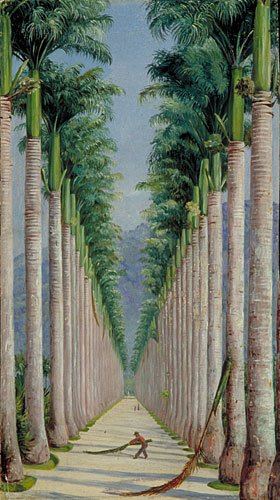
Royal Palm - Picture Credit - The Royal Botanical Gardens Kew
Used for over a century to line wide boulevards and upmarket streets, the Royal Palm is as grand as its name. Its smooth trunk is a common feature in the tropics. Originally native to the Caribbean islands. Royal Palm facts: height 25m, latin name Roystonea regia
One of the few Palms that can thrive in the cold is the Chusan Palm. Found in central China. Chusan Palm facts: Height 20m, latin name Trachycarpus fortunei
Other notable Palms in the Arecales order of flowing plants include:
Brazilian Wax Palm, Sago Palm, Raffia Palm, Palmyra Palm, European Fan Palm, Chilean Wine Palm