I really used to like driving, but these days it reminds me of Darwin’s theory of evolution. In this case it’s complete failure to root out the dimwits that cross the road in front of me when driving.
Pedestrians – An endangered species?
Driving home on an average evening I am spending a small fortune on brake disks as they gather by the side of the road and wait until I am all but a few metres away, going at 30 mph, and then they strike. Now I’m all for freedom, but in the UK there are no jaywalking laws, which means any idiot can cross the road at any point, and at any time. But why, when I am traveling at 30 mph do you start crossing the road just metres in front of me, WHY!
Perhaps this inability comes with the UK’s declining ability to do maths. Did these mindless souls miss the day the teacher did the whole “A car a is traveling at 30 mph… How long until it hits you?” thing. Or am I being unkind. How can anyone do maths and text, surf, and chat at the same time. Perhaps, and it’s just a suggestion, you mindless idiots, you could wait until you have crossed the big noisy thing with the loud whizzy things that kill.
The “I have enough time to walk across the road, but after stepping out I’m going to walk progressively slower so that it takes me about 5 minutes to get across the road” crowd really grinds my gears. Especially the ones that then look surprised and get angry that, no, you did not adjust your speed because they were a complete idiot.
My real frustration though is reserved for the sub-species, Pedestreeus Nolookus. These arrogant/ignorant creatures think that divine intervention is working overtime. They walk across a busy road right in front of oncoming motor vehicles without looking, and crossing diagonally with the flow of traffic. God help you if you honk your horn to warn them, because if they don’t have the “freeze rabbit in the headlight” gene, then they have the “Daily Mail, I’m always right” gene. Either way, your sound warning that their life is in danger will not make a jot of difference!
At the rate we are going, we will either be driving at 5 mph forever, in which case there will be no point in going anywhere. Or we will be mowing down so many pedestrians, we will have killed off the economy and not be able to afford to drive. I’m going to do the human race a service and petition the United Nations to put pedestrians on the endangered species list, because they need protection from themselves.
As the latest man made addition to Mars prepares to set down, we take a look at the Mars rovers that have traveled to the red planet on their missions to explore it’s surface and potential for life.
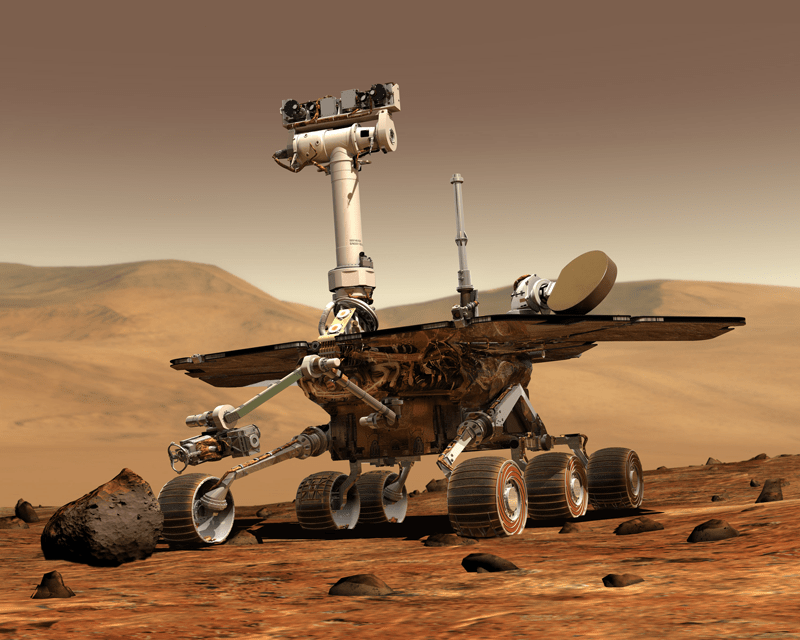
A Mars rover on the surface of mars – image JPL NASA
Mars rovers – A quick history
The Mars rover program has been a series of missions, sometimes successful, and something not. Of the six missions, today three have been successful. Given the cost of getting a Mars rover to it’s workplace, failure comes at an enormous price. In the case of the UK led mission, Beagle 2, the cost was £45 Million. This cost would have been far higher had it not been for Beagle 2 hitching a ride on the ESA’s (European Space Agency) Mars Express mission. The ESA’s cost for that mission to Mars was around 300 Million Euro.
The Successfully deployed Mars rovers from the last six missions were: Sojourner, Spirit MER-A, and Opportunity MER-B. So that’s USA 3, UK 0, and Russia 0.
The current Mars rover mission – A rover called Curiosity.
The current mission is about to attempt the most precarious stage of it’s long journey, since launching from Earth in early 2011. The Mars Science Laboratory, a bit of a mouthful, is scheduled to land on August 6, 2012. Only then will we know if the rover, Curiosity, has arrived safely. The NASA/JPL project has cost $2.5 billion to date and is the most ambitious martian science experiment to date.
The next mission to Mars
Mission 8 – ExoMars, by the ESA. Scheduled to launch in 2018.
Updates
July 17th 2012: With less than a month to go before the landing it’s all looking good for the Mars Science Laboratory mission and it’s payload, the Mars rover Curiosity.
August 6th 2012: Curiosity has landed safely on the surface of Mars.
When does a photographer’s liberty to take images of the world he sees around him need to be compromised in the name of security? With the Olympic Games in London this year a number of photographers and newspapers have been discussing this issue.
Security vs a Photographers Liberty – image by Ben Spencer
Photographers’ rights in the UK
First let’s take a look at the photographer’s rights in the UK. Amateur Photographer magazine’s handy wallet size printout reflects advice given to police offers by the metropolitan police dealing with photographers’ rights as follows:
There is no restriction on people taking photographs in public places or of any building other than in very exceptional circumstances.
There is no prohibition on photographing frontline uniform staff.
The act of taking a photograph in itself is not usually sufficient to carry out a stop.
Unless there is a very good reason, people taking photographs should not be stopped.
Officers do not have the power to delete digital images, destroy film or to prevent photography in a public place under either power (sections 43 and 44 of the Terrorism Act 2000).
Personally I like this simple set of guidelines, but it does not address the issue of taking photographs on private land, and does not mention taking photographs of individuals, with, or without their knowledge and consent.
For a more in-depth look at photographers’ rights, you would do well to pick up a copy of “Know your rights” published as a fold out A3 guide that came free with Digital Camera magazine’s spring 2012 Issue. This guide has sections covering shooting from public vs private land, the issues surrounding the police vs security guards, the implications for personal and commercial photography, photographing people in public, copyrighting and trademarking your work, and capturing animals and plants.
In my view, the above referenced guidelines mean that if you are shooting on public land, even if the subject matter is a private building, you cannot be stopped for doing so by security guards, or police officers unless you are causing an obstruction.
The National Interest
Now let’s think about the need to protect the national interest and the population. What are the threats and how could a photographer risk the nation’s safety?
Clearly a 7/7 or 9/11 style terrorist attack on an Olympic venue could be a distinct possibility at this summer’s London Olympics.
Individuals and / or the public at large could be targeted in the run-up to the Olympics.
Any major terrorist attack would likely need to be planned in advance, and clearly reconnaissance photographs by members of a terrorist cell could be used in the planning of such attacks. So there is a chance that a photographer taking a shot of an Olympic venue or staff involved in the Olympics, whether from private land or public land, could be on a reconnaissance mission as part of planning for such attack.
Clearly it would be desirable that if such a reconnaissance mission were taking place, then the national security services, police services, and private security services had the ability and tools to identify and stop such an event. Stopping a terrorist from researching his attack is clearly in the national interest. How do you identify and separate the bad guys from the photographer following his or her hobby or profession?
Having a law restricting all photography of Olympic venues would most probably be ineffective, given the amount of visitors expected before and during the games. So what then is the correct balance? What rights should our security services, both private and public, have to help them perform their duties and protect the Olympics and the nation?
Finding the Balance
So is it right then that a balance between a photographer’s liberty and the need for security be found, even if just while high profile events such as the Olympics are taking place?
One argument often made is that, if a photographer going about his or her business is completely innocent of any terrorist activity, then why should they mind being asked a couple of questions by security staff and or police? Surely national pride would bring us all together to protect the nation by allowing Olympic venues and their visitors to be protected though a temporary right to screen individuals in the process of capturing images. It’s the old “if you have nothing to hide, what’s the issue” argument.
The counter argument has always been that any such infringement into the liberty of a photographer will be the beginning of a slippery slope with Orwellian 1984 overtones. I wonder what Shami Chakrabarti, director of the human rights organisation Liberty and regular panellist on the BBC’s question time show, would think.
If we did start giving law enforcement and security services the right to stop photographers taking pictures of Olympic venues from public spaces, who should have that right? Just the police, or should private security services protecting a venue also have that right?
One thought to inject here – The games are a national affair, they are largely paid for by the public purse, and they are produced by LOCOG on behalf of the government. The Olympics by their very nature are a public event. So, if we are taking photos of a public event from a public piece of land, perhaps this without question means that private security firms should not be allowed to hinder or inspect the photographer. The Guardian recently published an article looking at just this issue. The link can be found in the links section below.
Conclusion
Where do I stand as a photographer and ex security guard; a perspective right in the middle of the picture?
I will get straight to the point here. If I am on private land and I am taking photos of security operations, I have no issue with security staff or police asking me to stop. They are clearly acting in a manner to protect the venue. The crossing of the boundary onto public land only changes who should be able to stop me. At this point, I would feel it completely inappropriate for private security firms and individuals to have powers to stop me or even question me. However, I have no issue with their right to be vigilant and escalate a situation to the police. If the police were to get involved, I would also have no issue with needing to explain my reason for being somewhere, or why I was taking photos.
Now I’m sure a number of readers will be up in arms at this point; “How dare a photographer be willing give their rights away!” In reply, I believe there are times in life where we should think about the many and not the individual. There is a clear need to protect sensitive venues from a potential terrorist attack, so I have no issue with giving a bit of my personal liberty up to protect the public. However, ask to take my camera, or try and delete my images without my express permission, no matter what the situation, then I will not budge without a court order.
References and Links
The Guardian’s piece mentioned in this article can be found on their website here: Guardian article.
The Guardian article is referenced by Amateur Photographer Magazine in their narrative on these issues, which can be found here: Amateur Photographer article.
Amateur Photographer Magazine’s handy print out guide to photographers’ rights can be found here: Amateur Photographer Printout.
The image behind the story
The image used in this article was created by Ben Spencer, our resident photographer. In his article “Constructing an image using Photoshop and Lightroom”, he describes how he created the image, from the day of shooting to the post shoot editing. You can find the article on his photography blog here: Ben Spencer Photography.
About the Author
Matthew Richmond is a keen blogger, photographer, and ex security guard living in Essex.
Caldera, or caldaria to give them their Latin name, are cooking pot shaped depressions in the earth formed after the cooling magma chamber of a volcano forms a void and the rock above collapses.
Spring in the yellowstone national park caldera
These collapses can be sudden or take thousands of years. When a caldera is formed by the implosion, dropping of rock, there can be significant atmospheric disruption that can have global consequences. The caldera formed after Krakatoa caused the world’s temperature to drop significantly.
Crater Lake caldera with Wizard Island shown
Crater Lake caldera, USA
Perhaps one of the most iconic and most photographed caldera of all time is Crater lake in the US state of Oregon. Its geology and inspiring natural beauty led the area to become a national park in 1902. The caldera is a remnant of mount Mazama, an ancient strato-volcano and formed some 7 to 8 thousand years ago. The lake is the deepest in the United States at a depth of 594m. Set within the caldera lake is Wizard Island, this volcanic cinder cone rises up out of the caldera’s lake water to its peak, where its crater effectively creates a caldera, in a volcano, in a lake, in a caldera, in a volcano; an example of a stacked caldera.
Caldera – The What and How?
Caldera are formed from two district types of volcano, The strato-volcano and the shield-volcano. A strato-volcano, or composite volcano, is a conical volcano built up by many layers. An example is mount Fuji in Japan. Strato-volcanoes have steep sides as they are built from lava that cools quickly and does not travel very far, hence each eruption builds layer upon layer. Shield volcanoes are characterised by a flatter and much more spread out footprint, which is due to their formation from fast flowing lava that tends to form large fields.
Santorini caldera Greece
Santorini caldera, Greece
Sometimes these geological features are visible above ground, and sometimes they are concealed by water. The Greek island of Santorini’s caldera is at first glance not visible, it is only when you realise the islands of Santorini form an almost perfect circle that the caldera becomes obvious. The Santorini caldera has been submerged in the Aegean sea, leaving only the sides of the strato-volcano that it formed from jutting out of the sea to form the Greek island that bares it name. It is thought that the giant explosion that created the Santorini caldera was responsible for the end of the Minoan civilisation with the resulting tsunami and the collapse of land leading to the birth of the legend of Atlantis.
Types of caldera
There are three well documented types of Caldera. The crater type, basaltic calderas, and the resurgent calderas. In essence what these types represent is where and how many collapses have caused a caldera to form. A resurgent caldera is the result of more than one collapse. Basaltic calderas are the result of shield volcanoes collapsing. These types of collapse tend to happen slowly, while crater or lake types tent to be the result of strato-volcanoes’ magma chamber voids collapsing, often at explosive rates.
yellowstone lake caldera – image stock.xchng user RinskeBlok
Yellowstone caldera, USA
Yellowstone National Park in the western United States is essentially one massive caldera. The Yellowstone caldera is the result of resurgent activity over thousands of years. What makes Yellowstone unique is that the magma chamber that has formed under the surface here is relatively stable, while the earth above it is moving glacially across the magma chamber’s surface.
Taal Lake caldera
Taal lake caldera, Philippines
The Taal lake caldera in the Philippines has a chequered past, with much death and much life. A strato-volcano some 60km south of Manila, it features a lake caldera lake some 22km in length. There have been thirty or so eruptions and caldera collapses since the mid 1500s that have been responsible for thousands of lives being lost. Some of the people killed were thought to have perished from tsunamis forming in the lake from the force of the eruptions. It is one of the few places on earth that has experienced inland tsunamis or ‘lake tsunami.’ Today the lake supports many fishing villages, with fishing and tourism the main source of income. In summer 2011 a mass die off of fish was caused by a sudden change in the lake’s water temperature. It is unclear if this was down to a geological volcanic event.
Caldera de Bandama Gran Canaria – image flickr user El coleccionista de instantes
Caldera de Bandama, Spain
The Caldera de Bandama on the island of Gran Canaria in the Canary Islands, located off the west African coast, is one of the worlds most accessible calderas. The tip of the volcano that the magma chamber which collapsed forming the caldera forms an excellent vantage point to over look the deep depression. There is also a well-trodden path winding its way down to the centre of the caldera that takes about 90 minutes to walk. It’s easy to imagine yourself descending into a prehistoric world.
Laacher See caldera, Germany
The Laacher See is a caldera in the Rhine Valley of Germany some 30km south of Bonn. It has a caldera some 8km wide and its lake has been studied since ancient times. The caldera is part of the Eifel field of volcanoes arising from a mantel plume under the European continent. The ash from the eruption some 13,000 years ago that formed the caldera can be found throughout central Europe and the North sea. The caldera and volcano beneath it could still be active, as CO2 seeps out of the rock and bubbles up in the lake; this is likely to be caused by magma degassing under the lake. In ancient times, according to folklore, medieval monks sleeping nearby were overcome by a CO2 cloud steaming from the lake, and died. Interesting Everything has not found a photo that we can use as yet for this caldera. If you know of one please comment below.
Ardnamurchan caldera rising in the background – image flickr user Grégory Tonon
Ardnamurchan caldera, UK
Ardnamurchan caldera in Scotland is the UK’s biggest Caldera. The western end of the Ardnamurchan peninsula in Scotland contains a complex of volcanic structures that collectively form a giant Caldera. The caldera is best viewed from the air, as the relatively shallow depth of its bowl compared with its great size make it difficult to see from the ground. The photo we have used is actually of the beach that sites at the foot of this caldera. You can see the walls of the colapsed volcanic activity in the background of this photo. If you have some time, take a look at Google maps and select the terrain view. You can easily see the ring of concentric peaks surrounding the caldera bowl. The area today is populated by smallholdings and grazing animals. The end of the Ardnamurchan peninsula is the most westerly point in the UK, and further west than some parts of Ireland!
pinatubo crater lake caldera – image flickr user Wongaboo
Mount Pinatubo caldera, Philippines
Pinatubo caldera is an example of nature in action. It is one of the worlds newest and most reported caldera lakes. Formed after water filled the caldera created by the relatively recent eruption in 1991. Due to concern over flash-floods which could be caused by the crater walls collapsing, work was carried out to drain some of the water from the lake, a world first! After the works were completed it was found that the rock was of a harder type than thought, and the caldera was allowed to re-fill.
The world is full of odd little bits of land that are, in political terms, separated geographically from the rest of the country they are a part of. Some of these divisions cross continents, and where they do they become trans-continental exclaves.
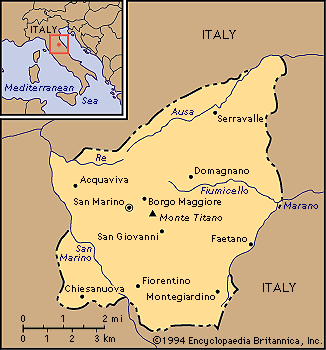
A quick diversion here to cover the other oddity of political geology, the ‘enclaved counrty.’ Enclaves, not to be confused with exclaves, are countries whose boundaries lie entirely within the boundaries of another country. Italy, for example, has two enclaved states within its borders; The Vatican City is the smallest country in the world and is enclaved in the Italian capital Rome. Italy’s second enclave San Marino, the home of the Ferrari, lies 314 kilometres to the north of Rome.
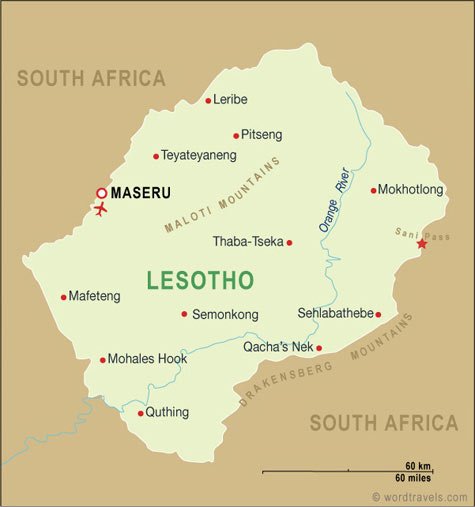
Other enclaved countries are: Lesotho (which sits within South Africa) and, depending on your view of indigenous peoples, there are the tribal nation lands, or Indian reservations in the United States and Canada.The country of San Marino, an enclave with ItalyThe Vatican City: the smallest country in the world, and an enclave within Italy and the city of RomeThe country of Lesotho, an enclave of South Africa So then, to exclaves. These pieces of land offer some interesting quirks of international dispacement, and ways of leaving whole continents with a single journey between two places of the same country!Map of Melilla, an exclave belonging to Spain (Europe) but located in North Africa Take, for instance, the Spanish exclaves of Ceuta, Melilla, and Penon de Velez de la Gomera. Take a pleasant boat trip across the Mediterranean sea from the mainland of Spain on the Iiberan peninsula and you will find yourself in Africa! Spain has 3 nice little bits of Africa that it maintains sovereignty over, plus the islands of Isla del Perejil, Isla de Tierra, Isla de Mar, Penon de Alhucemas, Isla de las Nubes, Isla de Alboran, Isla Isabel ll, Isla del Ray, Isla Congreso, all if which are situated just of the coast of North Africa.Penon de Velez de la Gomera, an exclave of Spain in North Africa One of Spain’s exclaves has the distinction of having the world’s shortest land border – some 85 metres no less! The exclave of Penon de Velez de la Gomera is really just a rock fortress on the cost of north Africa, that formed when a storm in 1934 caused a small island to be connected to the mainland by a permanent bridge of sand, or isthmus. It is this sand isthmus that form the international border! Video of the Spanish exclaves in North Africa
As winter sun holiday destinations go, the Canary Islands are one of the more well known places in the world for sun worshippers and grey sky dwelling northern europeans to head south to for the winter. What is less well known is the impact that the islands’ volcanic past have in store for the East Coast of the US, if volcanologists’ and oceanographers’ predictions of a mega tsunami are realised.
Tsunami hits the statue of liberty – image credit unknown
Over the last few weeks, a rumbling volcanic eruption and earthquakes in the seas around the island of El Hierro in the Canaries have re-ignited the debate on the the Mega Tsunami predicted to hit the Eastern Seaboard of the US. The debate centres on a theory that focuses on a tsunami being caused caused after a large chunk of volcanic rock falls into the sea from the Cumbre Vieja volcano on the island of La Palma.
Part of this volcano is highly unstable and could collapse into the ocean at any time. If this were to happen 20,000 cubic meters of rock could fall into open sea water and, channelled by the seabed geology, create a mega wave (Tsunami) travelling at 500mph in all directions.
tsunami triggered by land slide on the island of La Palma. image credit – telegraph.co.uk
The path of destruction caused by the wave would be as follows. African nations of the western Sahara would be hit first by waves of 330ft, followed by southern Europe, then northern France, Ireland, and the UK. The eastern seaboard of the United States would be hit within 7 to 8 hours of the event, causing widespread devastation. A wave making landfall at a height of up to 200ft would hit the metropolises of Boston and New York, then the Tsunami would travel south along the coast, taking out beachside communities all the way to Miami and the Florida Keys. According to Dr Simon Day, of the Benfield Greig Hazards Research Centre (University Collage London, UK), its not a question of if this happens, but when!
However, if you live in the suggested path of this mega tsunami, don’t start moving just yet! Many other scientists believe that these events are highly unlikely, as the rock that could cause such an event is far more likely to break up into smaller chunks, and be dispersed over a considerably longer timeframe than it would take to cause this Tsunami.
Some of you may know that triskaidekaphobia (pronounced triss – kai – deck – a – foh – bee – uh) is not only the fear of the number 13, but also a great word to trot out when trying to impress, or perhaps just appear to be a random geek. Gamblers may avoid betting on the number, while some other worriers will avoid all sorts of travel on the 13th day of the month, especially if it falls on a Friday.Lucky for Some? As is often the way, worldwide cultural differences mean that the fear of the number 13 is particular to the west, whereas in Asia a fear of the number 4 is more the norm.
Strangely enough, I got to thinking about triskaidekaphobia when studying the results of
last Friday’s UK Euromillions lottery draw, which created decent chunk of extra millionaires, an indeed worthy thing to do which will be repeated on Friday 23rd December.
UK lottery operator Camelot is unusual in that it operates a UK only raffle as an ‘add on’ to each twice-weekly Euromillions draw, perhaps in part to mop up the surplus cash created by the exchange rate differential between the UK price of £2 sterling for a ticket as opposed to the lesser value of €2 charged in Europe. It turns out that you don’t choose the raffle number, the lottery chooses it for you, and automatically allocates it to your ticket.
All this may help formulating strategies to maximise a win on the main draw itself, where you have the power to choose your own numbers or to leave it to the chance known as a ‘lucky dip.’ Since you can’t accurately predict the numbers to ensure a win, perhaps the next best thing is to avoid the numbers that most other people pick, in order to ensure that you share any win with as few people as possible. Thus, in the UK, “lucky 7” might be worth avoiding, and “unlucky 13” to be worth considering, to compensate for the fact that fewer than most may have chosen it. Of course, the number 13 has as much or as little chance of any other number as coming up, but if it does, along with your other selected numbers, you may be lucky and win a bigger prize as a result.
Then your only problem to overcome is the fear of losing your money in the first place, and with odds of 1 in almost 117 million of hitting the Euromillions jackpot, that’s a very understandable fear. It’s called Antichrometophobia.
Keen Brit-watchers must be wondering what the hell’s happening over here right now. We’ve just had our own peaceful version of a one day civil service strike, or was it merely a day of protest? Compare and contrast with Greece for example, and we seem to have been terribly British about the whole thing, yet in our unique island way the Brits are certainly revolting.
Take on the one hand the civil servants. Many are portrayed sympathetically by the (often accused of politically correct, left-wing bias) BBC as only striking for the first time ever, betrayed by an untrustworthy government seeking to renege on their employment terms and conditions, especially their long-standing and pension agreements (which pay massively generous returns compared to the private sector.) Many of them genuinely feel they have worse compensation packages than those in the private sector.
Meanwhile, firmly in the ‘blue’ corner, you’ll find the Rupert Murdoch owned press. Desperate, some might say, to curry favour with the UK’s centre-right coalition as the current Leveson Inquiry into the UK’s press standards, somewhat hijacked by miffed celebrities, rolls on. The Times and The Sun are telling us that the civil servants are wrong, and citing data compiled by the well-respected Institute of Fiscal Studies (IFS) to back them up.
Arguments roll on about the success or otherwise of the strike*/protest* (*delete as appropriate.) Was a turn-out two thirds of the size expected by the unions a ‘damp squib?’ I’ll leave that for you to decide. What interested me was some of the detail coming out of the IFS.
For example, government plans to cap public sector pay rises at 1% a year until 2015 will wipe out the pay premium that the civil servants have over the rest of us. While this may make uncomfortable reading for the averagely paid civil servant that baulks just as much at the mega-earnings of a small number of city bankers as the rest of us, that’s just tough – civil servants are, officially, it seems, 7.5% better paid than those of us in the private sector. That 7.5% difference between us has to be even greater if you strip out the skew arising from the mega millions being earned in the square mile.
Most of us private sector employees would probably live with this if it were the only difference. However the pensions issue has become a deeply divisive one over the last couple of decades. As one civil service union official helpfully pointed out yesterday, their pension contributions go to the government (ours go to pensions providers) and the government (i.e. all of us) has to pay out civil service pensions, which the unions claim are affordable.
And there’s the rub. Despite the financial crisis and record government borrowing, affordability isn’t actually the main issue – fairness is. Now don’t get me wrong. I sympathise with the civil servants. It hurts to be told that you have to pay in more to get less out. All of us in the private sector already know this to be the case, because we’ve had to deal with it ourselves for long enough since the private pensions market went sour.
It’s simply against the British spirit of fair play to let the civil service keep their cast-iron pensions while many low paid private sector workers already earn less and can also expect to retire into pension poverty. If the market return on pension contributions is X%, then that should apply across the board, public or private sector. Anything less just won’t wash, and I’m predicting that civil servants will see sense, and stop complaining about how bad their lot is, and quietly go back to counting the size of their pension pots compared to ours.
The battle of Salinas, California is about to be repeated in our epoch of unrest, and this time there is no Steinbeck to highlight the plight of the dispossessed working classes. Already in the UK we have seen discontentment and lack of work spill out into the streets, only needing an ignoramus spark like the shooting of Mark Duggan this August in Tottenham to tip anger into mass unrest. While in most individuals involved in the riots their misplaced anger was ill defined, it is clear that with this wednesdays public sector union backed strikes, the country will see the biggest organised revolt of our times.
Who then is to stand up for the working classes this time. Will Billy Bragg come out of retirement to re-unite a cause? Steinbeck’s Grapes of Wrath, captured the anguish of the dust bowl generation in Americas midwest transients journeys to the land of California in the 30s. In the book, the Okie’s reached the state boarder with California at Needles, where on crossing the bridge across the Colorado river from Arizona after a long trek down the mother road of amerrica, route 66, they found the first signs that they were heeded into a new hell from which they had traveled so earnestly in search of food, waterer and shelter.
The State of California, had for the first time in US history started to vet US citizens as they crossed over. Internal migration had become the biggest issue of the day in California. Surprising then as now, as California’s agriculture relies on seasonal imergrational workers to harvest its bounty. So here are parallels with the UK in modern times, the mass wave of Eastern European migrant workers that arrived in the UK and found work on our farms and building sites has prompted a new call for restrictions and vetting of immigrants as we hit hard times.
John Steinbeck - Image AP Photo
Since the decline of manufacturing in the UK, there has been internal migration, with a population shifting from areas of low unemployment to find work and a new life. Now however as we face what could be a defining European lead UK felt double dip recession, those internal European economic migrants are having to start justifying their way within the UK, as comunites start to question where there jobs are going to come from it is again the migrants facing the wrath.
So where then do we go from here, Steinbeck opened the eyes of the world to the plight of the disposed in the US, and the eyes of the world are again open to the issues we face today, but unlike in Steinbeck, we have no champion to speak for the jobless, hungry and angry youth. Perhaps the answer lies in communities accepting the need to heal thyself through charities and communal labour. Why not a national series of Infrastructure projects to create jobs and give the restless an outlet for the frustration though work. We could use the communists mantra “Workers of the world unite”. We have a potential paymaster with China, as they look to invest trillions of Yuan in the UK and Europe to prop up the world economy.
Before you start to judge this post, as a manifestation of communist leanings, much like Steinbeck was wrongly berated for his thoughts on humanities struggles, ask yourself where we can inject the growth that our capitalist economies relay on for their stability. We have no capital of our own for such projects, and as the worlds economies are becoming tightly integrated the problems of contagion need a global sticking plaster.
“The things we admire in men, kindness and generosity, openness, honesty, understanding and feeling are the concomitants of failure in our system. And those traits we detest, sharpness, greed, acquisitiveness, meanness, egotism and self-interest are the traits of success. And while men admire the quality of the first they love the produce of the second.” — John Steinbeck
Cash Till adapted for hope – Original Image – Flickr user MrVJTod
Hope is a powerful tool, and you can consume it for a pound a week. Figures announced this week show national lottery sales have gone up 20% in a year. Considering we are in economic hard times, with return to recession in a so called “double dip”, why are people spending what little money they have on a quick gamble?
I believe it is because the thing that many of us turn to in our darkest hours, Hope. Hope is now not only cheep to buy, but it lasts. If you time your lottery ticket purchase just right, you can spend all week holding out with a little expectation that you will be the next big winner. It’s cheeper than a pint of beer, and most people except a £1 a week on the national lottery is not a gateway drug to a more serious addiction to gambling. It is certainly more socially acceptable than other vices that people turn to in hard times, drugs, alcohol, cheesy pop music.
What would a marketer, make of this potent product called hope, could we see banners up and down the highways and byways stating “Buy Hope, it will get you though!” or “Hope, it’s cheep at half the price”. Perhaps the ultimate lost leader “Hope, it’s free and its good for you”, small print, “can cause delusions that could negatively affect the outcome of your existence”.
Cynical, perhaps, but all said and done, i’m all for hope dear readers and I hope you are too! Go on, go mad with audacity and buy a bit of hope today!